We need policy solutions now. Declining fertility rates threaten sustainable futures
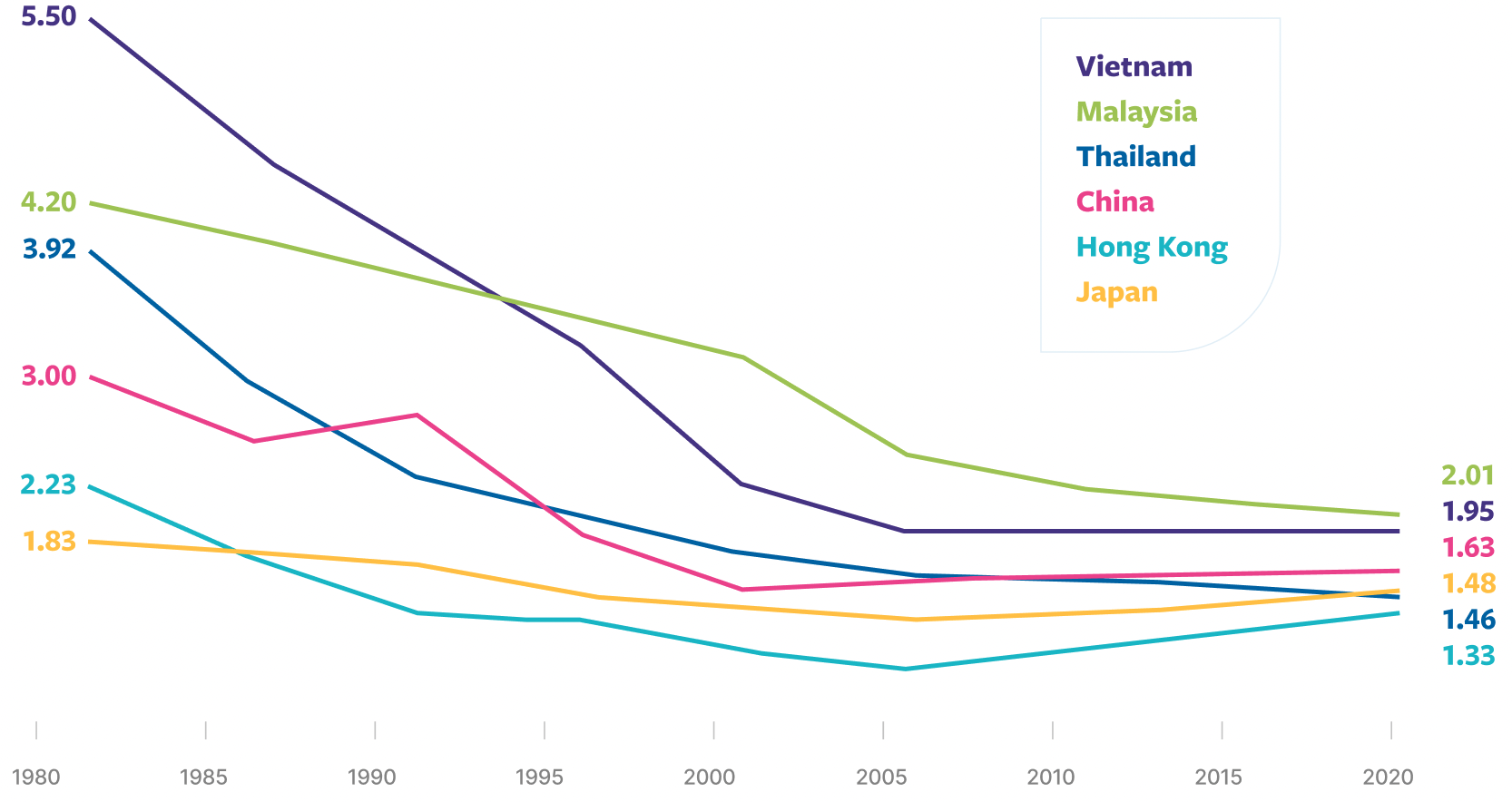
When fertility falls below replacement rates, this has socioeconomic ramifications. The birth rates of many APAC countries have dramatically declined in the past 70 years, impacting both population size and structure1.
Total Fertility (live births per woman)
Produced by (E) BrandConnect i
https://population.un.org/wpp/DataQuery/ accessed May 2019
Produced by (E) BrandConnect, a commercial division of The Economist Group, which operates separately from the editorial staffs of The Economist and The Economist Intelligence Unit. Neither (E) BrandConnect nor its affiliates accept any responsibility or liability for reliance by any party on this content
We need to act now. The Policy Toolkit looks at common barriers for people who want to have children, and policy solutions that can help overcome these barriers. It also contains an analysis of which interventions are most effective, based on different country variables.
The toolkit is designed to help advocates and policymakers identify the policy interventions that could make the most impact in their country, so they can provide the support that is most needed and drive effective change. It is based on data from around the world, and input from a panel of experts.
The Fertility Policy Toolkit was developed by Economist Impact and sponsored by Merck.
-

No Poverty
End poverty in all its forms everywhere.
-

Good health and well-being
Ensure healthy lives and promote well-being for all at all ages.
-

Gender Equality
Achieve gender equality and empower all women and girls.
-

Reduced inequalities
Reduce inequality within and among countries.
We need policy solutions now
We count on fertility for our future
The average number of children born per woman has decreased by half globally since 1960. In the APAC region, it has decreased even more, from 5.4 in 19602 to 1.8 in 20201.
This is a particular concern, because APAC is an economic powerhouse, and falling fertility rates have the biggest socio-economic impacts in countries with fast-growing economies.
Interventions that support fertility also support four of the UN’s Sustainable Development Goals1.
For more details, visit the UN’s Sustainable Development Goals website.
Breaking down barriers to accelerate progress
To identify the right policies to support fertility requires an understanding of the expected impact, benefits, and challenges. The toolkit explores all of these aspects, along with examples of policy implementation, to guide users to the best solutions for their needs.
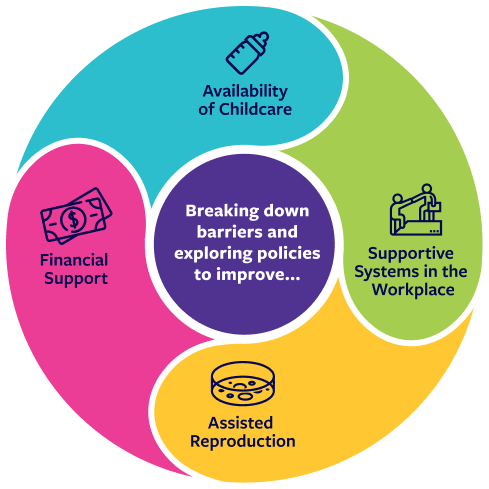
Breaking down barriers to accelerate progress
To identify the right policies to support fertility requires an understanding of the expected impact, benefits, and challenges. The toolkit explores all of these aspects, along with examples of policy implementation, to guide users to the best solutions for their needs.
Download the toolkit for the full analysis of each policy
Download the toolkit for the full analysis of each policy
Enhancing impact through a mosaic of family-friendly policies
Family-friendly societies and policies are vital to support healthy populations. The toolkit outlines these complementary policies and the impact.

Enhancing impact through a mosaic of family-friendly policies
Family-friendly societies and policies are vital to support healthy populations. The toolkit outlines these complementary policies and the impact.
Download the toolkit to see the complementary policies
Download the toolkit to see the complementary policies
Choosing the right policy solutions for your country
The APAC region is incredibly diverse. No two countries have the same demographics, economy, culture or institutions. So policy solutions should be tailored accordingly.
To help countries identify the right policies for their needs, the toolkit outlines four country archetypes and the corresponding policy interventions that would be most effective.

Choosing the right policy solutions for your country
The APAC region is incredibly diverse. No two countries have the same demographics, economy, culture or institutions. So policy solutions should be tailored accordingly.
To help countries identify the right policies for their needs, the toolkit outlines four country archetypes and the corresponding policy interventions that would be most effective.
Download the toolkit for detailed archetypes
Download the toolkit for detailed archetypes

What you’ll find in the toolkit
- Why fertility rates are declining
- Why this matters for our future economies
- What we can do about it
The Fertility Policy Toolkit has the following components:
- Policies and policy areas
- Impact on fertility rate
- Who these policies are most impactful for
- Economic benefits
- Facilitators
- Barriers
- Country transition stage/archetype most suited to policy
- Implementation examples
- Complementary policies
1. United Nation’s sustainable development goals https://sdgs.un.org/goals
2. The Economist Group (2023) . Fertility policy and practice: a Toolkit for the Asia-Pacific region.